University of Minnesota
http://www.umn.edu/
612-625-5000
Home
Make a Gift
VHLabs

HeartDatabase

Right Atrium
Right Ventricle
Pulmonary Trunk
Left Atrium
Left Ventricle
Aorta
Coronary Arteries
Cardiac Veins
External Images
CT Images
MRI Images
Comparative Imaging
3D Modeling
Plastinates

Anatomy Tutorial
Bifurcation Stenting Tutorial
Cardiovascular Magnetic Resonance Tutorial
Comparative Anatomy Tutorial
Conduction System Tutorial
Congenital Defects Tutorial
Coronary System Tutorial
Device Tutorial
Echocardiography Tutorial
Physiology Tutorial

Project Methodologies
Cardiovascular Devices and Techniques at U of Minnesota
Acknowledgements
References and Links
Atlas in the media

Surgery Department
Principal

 
Bifurcation Stenting Tutorial
Provisional T/TAP Culotte Crush
Step-by-Step Stenting Procedure
 
Stenting Procedure Videos
 
Stenting Procedure Models
 
Bifurcation Stent Anaglyphs
 
Bifurcation Exploration

(External link to medtronic.com)


T/TAP Stents


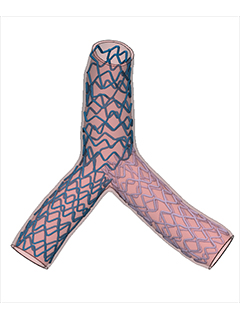
T 3D Model

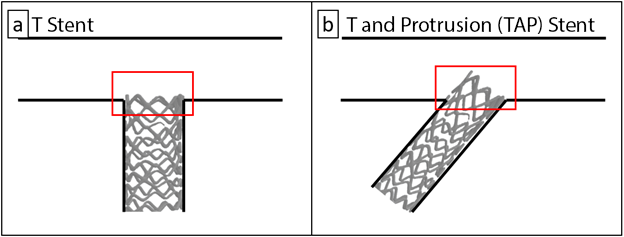
The T/TAP stenting approach can be an independent stenting technique or used as a bailout approach when a Provisional stent does not leave enough flow to the side branch. As a main stenting approach, they are commonly used with side branches at an angle over 70 degrees, up to 90. A T procedure is best deployed at 90-degree angle branches and does not leave any struts (protrusions) from the second stent in the main vessel. Due to better alignment of the end of the stent with a "flat" side angle there is minimal stent on stent interaction. When part of the side branch stent is left in the main vessel due to vessel angle, these procedures are called T and Protrusion (TAP). These approaches start with a Provisional approach before adding in the side branch stent following a Kissing Balloon opens the struts into the side branch.


T vs TAP


© 2026 Regents of the University of Minnesota. All rights reserved. The University of Minnesota is an equal opportunity educator and employer. Privacy Statement
Report Web Accessibility Issues