Crush Stents
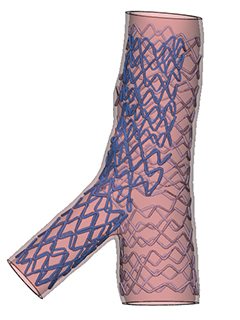
There may be instances where the interventional cardiologist may decide to purposefully crush a stent that has been placed. This is planned to be performed during the 'Crush' and 'DK Crush' techniques. These procedures always start as a two-stent approach, unlike Culotte or T/TAP which often arise as bailout procedures for Provisional stents. Crush procedures are optimal in complex or high-risk bifurcation lesions when compared to Provisional stents. In such scenarios, Crush stents have a lower risk of stent thrombosis or revascularization. They are also able to work with a more versatile range of branch angles. There are several variations of the Crush techniques based on how long the protrusion into the main vessel is. Traditional crushes have a 4-5mm overlap, while "mini" crushes have 1-2mm and "nano" crushes have 0.5-1mm. Current guidelines are recommending 2mm of overlap (the mini crush) to reduce the amount of overlapping stent material while still ensuring proper coverage of the full side branch ostium. Guidelines recommend nano crushes only when branch angles are close to 90 degrees.

Typically, a stent is initially placed in the side branch with part of its proximal end protruding into the parent branch. After stent deployment, a balloon that was already in position within the main branch vessel is inflated to crush the stent along the lumen wall. Original crush approaches used the main vessel stent to crush the side branch, but further research demonstrated that using a balloon instead results in better outcomes. This is usually followed by placing another stent in the main branch (see individual 3D models and videos for more information). Double Kissing or "DK" Crushes will have two Kissing Balloon Inflation steps during the procedure, with one occurring before the main vessel stent is deployed and another once both stents are in place.